HISTORY OF NOTTINGHAM ROAD
The Early Days
The land that would become Nottingham Road was largely uninhabited until the mid-1800s. It consisted of grassy highlands that flourished in summer but were cold and challenging to farm in winter. Voortrekkers arriving in the 1830s preferred farming further north, closer to markets, leaving this region relatively untouched until the arrival of British settlers under the Byrne Immigration Scheme in the mid-1800s.
Although most Byrne settlers remained near Pietermaritzburg, a few moved further inland in search of larger tracts of farmland. One reason for the area’s limited early settlement was its distance from markets in Pietermaritzburg, Durban, and Weenen, which made it difficult to earn a living.
Among these pioneers were John King and his wife Janet (née Ellis), who arrived in 1849 on the Henry Tanner with their infant son, James, and Janet’s siblings James, Helen, and Elizabeth Ellis. Their daughter Helen was born four months later.
Finding their allotted land unsuitable, they used the Sommerville inheritance of the Ellis siblings to purchase 6,000 acres of the farm Wilde Als Spruit, which they renamed Balgowan and Lynedoch. In 1858, John King acquired the farm Gowrie through the Quit Rent system. These farms, named after Scottish estates, remain part of the Midlands map today.
The Kings established a successful farm at Lynedoch and twice a year transported salted butter, cheese, wool, and preserves to Pietermaritzburg by ox-wagon—a two-day trip.
Early farming, however, was harsh. Settlers faced difficult conditions and, to survive, many turned to deforestation—logging the towering indigenous yellowwood forests on the south-facing slopes. Timber provided essential income, and through trial and error, farmers gradually transformed the land: liming the soil, fertilising, and planting improved pastures. These efforts laid the foundation for today’s thriving dairy and beef industry.
Strathearn & the Smythes
A trainee farmer employed by the Kings, Charles Smythe, immigrated from Scotland to Natal in 1872. On his voyage aboard the mail ship Norseman, he shared a cabin with two of Cecil Rhodes’ brothers. After early ventures in sugarcane farming and diamond mining, Smythe met fellow Scot John King and later partnered with King’s son, James, to farm Gowrie.
In 1876, Charles married Margaret King, John and Janet’s younger daughter—an accomplished stock farmer in her own right. The King, Ellis, and Smythe families all hailed from the same part of Perthshire, Scotland.
The couple had 14 children and farmed successfully at Strathearn, a property Charles expanded by leasing and eventually purchasing adjoining farms—Howard, Vaalkop (later Inchbrakie), and Eberberg. Smythe later rose to prominence as Prime Minister of the Natal Colony in 1906.
Today, Strathearn remains in the hands of Smythe descendants—over 140 years later—a testament to enduring local heritage.
Henry Winter & the Naming of Winterton
Another pioneering figure was Henry Winter, of Bavarian descent, who served as Minister of Agriculture in the colonial government. He is best remembered for initiating the Winterton irrigation canal system, which enabled effective crop irrigation and transformed the region’s agriculture. The nearby town of Winterton was named in his honour.
His legacy lives on through descendants such as Ian Mackay, Jessica Brown, John and Graham Armstrong, and others—including the Rafe’s, Elliotts, and Mark Winter—who continue to contribute to the farming communities in and around Estcourt and Nottingham Road.
Fort Nottingham
On the edge of colonial settlement, early farmers were vulnerable to Bushman (San) raids, particularly in the rugged Drakensberg foothills. These small, mobile groups raided livestock, prompting settlers to request protection from the colonial government.
In response, Fort Nottingham was established in 1856—initially as a military outpost and later as a pensioners’ village. Regiments such as the Cape Mounted Rifles, Natal Mounted Rifles, and later the 45th Foot (Sherwood Foresters) from Nottinghamshire were stationed there, giving the area its name. Today, the site houses the Fort Nottingham Museum, preserving this unique frontier heritage.

Wagon Trails & the Foundations of the Region
Curry’s Post was a vital stop on the old wagon trail between Howick and the interior, named as it served as the postal address for all farmers in the area. The Curry family, early settlers, established the Curry’s Post Hotel opposite today’s Fable restaurant. The first overnight stop from Howick was at Old Halliwell—originally Steve’s Eating House—followed by Curry’s Post, and then a crossing of the Mooi River below what is now Treverton.
Rosetta began as a railway siding and gradually evolved into a settlement. Two Herbert Baker-designed homes still stand on farms in the area.
Kamberg, meaning “Comb Mountain” in Afrikaans (after the mountain’s shape), became home to a thriving Afrikaans-speaking farming community that grew steadily through the 20th century.
The Railway & the Birth of a Village
The arrival of the railway—and the building of a station on the King family’s farm Gowrie in 1885—transformed life in the Midlands. Initially called Karkloof Station, it was renamed Nottingham Road Station in 1887. The railway linked rural farmers to Pietermaritzburg, Ladysmith, and beyond, enabling efficient transport of goods, people, and mail.
A village soon formed around the station. The land on which the Nottingham Road Hotel stands today was sold in 1889 from the Trust of Robert King of Gowrie to settle the Ellis investment in Lynedoch and Balgowan.
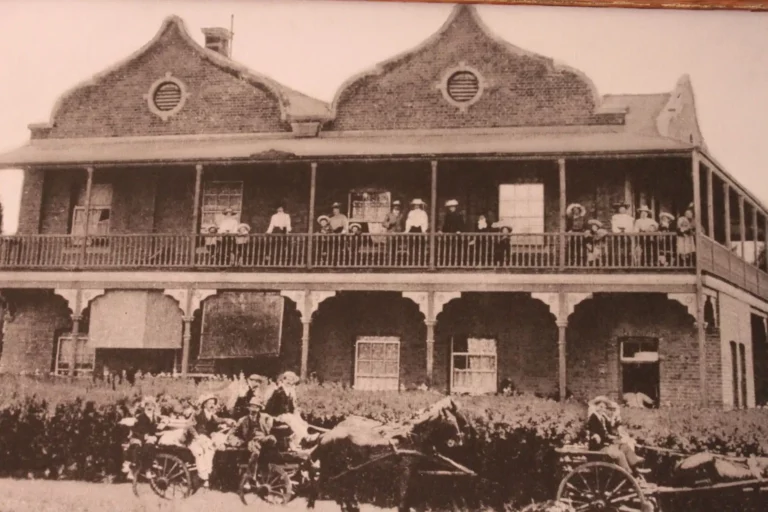
The hotel was later sold to George Orwin for the remarkable price of £125 per acre—at a time when Springgrove Farm sold for just £16/6 per acre. The Singleton family eventually took over the hotel, which became the heart of the community—a gathering place for farmers’ meetings and local events.
Local Legends
Over the years, many colourful stories emerged from the famed Notties Pub:
- Farmers who arrived on horseback lined up their horses in order of arrival. Mischievous patrons would swap them around, and slightly “shickered” farmers often rode home on the wrong horse, arriving at the wrong farm!
- Early motorists, finding the roads dreadful, sometimes drove home entirely in reverse—believing reverse gear to be the strongest!
- One farmer, after winning “Best Bull” at the sale yard (now Agrimark), proudly walked it over the railway bridge and into the bar, where a cow dung fight ensued. His aunt, upon hearing of the scandal, promptly disinherited him.
- Another local once rode a white horse into the bar and ordered a White Horse whisky while still mounted.
To this day, Notties Pub remains a symbol of local spirit and humour. The first inch (25 mm) of summer rain is still celebrated there annually.
The Bull and Ram Sale, introduced after WWII to boost the local economy, grew into the largest event of its kind in the country.
The local “Party Line” telephone exchange at the train station also served as community entertainment—people would listen in on conversations, learning plenty about their neighbours (and themselves).
The Farmers’ Association (now the NRLA) AGM was once a formal affair, jacket and tie required. Meetings were held at the Farmers’ Hall. After one particularly lively evening, Pauline Greene returned from church to ask her son Pete why the congregation had been praying for the young community, of which young Pete was a member—rumour had it they had been “a bit out of hand” the night before!
The Midlands Meander
Tourism in the region truly began with the creation of the Midlands Meander—a route celebrating local art, craft, food, and hospitality. Founded 40 years ago, it transformed farm roads and country life into a major tourism attraction.
The Bierfassl, a beloved Austrian-style pub in the old station house, has been welcoming locals and visitors for over 30 years, symbolising the Midlands’ enduring culture of warmth and hospitality.
A Thriving Farming Legacy
Today, Nottingham Road and its neighbouring areas—Rosetta, Balgowan, and Curry’s Post—remain strong agricultural centres.
Soil liming, pasture improvement, and winter feed supplements enable farms to thrive despite cold winters. Key dams—Spring Grove, Mearns, Sarsden, and Rondebosch—provide clean water, supported by responsible upstream land use.
The Greene family, in particular, played a central role in developing regional infrastructure and education, with Chris Brown establishing seven farm schools for rural children.

Education at the Heart of the Midlands
Education has always been central to Midlands life. Several leading schools were founded here:
- Nottingham Road Primary School – Established in 1895 by Rev. Cadman, who held classes in the Nottingham Road Hall. The current school building, completed in 1913, still serves the community.
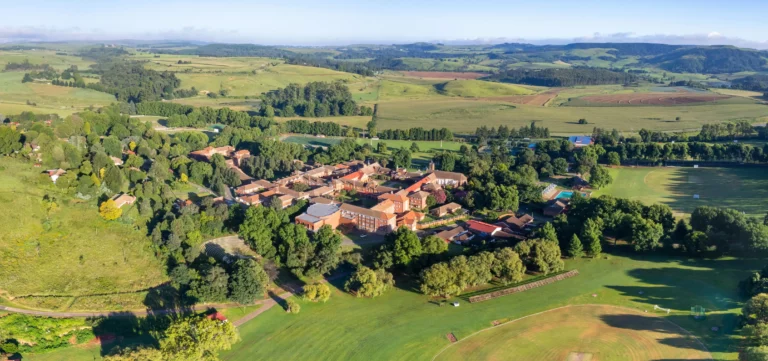
- Michaelhouse – Founded in Pietermaritzburg in 1896, the school moved to Balgowan in 1901, where it remains one of South Africa’s most prestigious boys’ schools.
- Clifton Preparatory School – Relocated from Durban to Nottingham Road during WWII (1942). The Greene family donated the land, and many of the school’s buildings are converted farm structures.
- Carlyle College – Originally a doctor’s residence and sanatorium, it is rumoured to be haunted by the doctor’s ghost. Named by its founder, Sidney Robert Edminson, after his alma mater at Cambridge, it later became St Winifred’s School, then King’s School, and finally Carlyle College in 2022.
- Farm Schools – Established to serve rural families, many were founded by community leaders such as Peter Brown.
Trout, Fly-Fishing & Legacy Tourism
With its cool rivers and mild climate, the Midlands proved ideal for trout. In the 1890s, Cecil Yonge released 1,500 trout fry into the Bushman’s River with government support. After several attempts, John Parker established the first trout hatchery on Boschfontein Farm, later relocating it to Tetworth near Curry’s Post. The Umgeni and Mooi Rivers were also stocked.Trout soon became a tourism draw. Families flocked to the Nottingham Road Hotel for fresh air, country food, and fishing—a tradition that continues today.
Gareth George’s WildFly now manages stocked dams and hosts annual fishing festivals.
Nottingham Road also remains a hub for equestrian sport, with polo deeply rooted in the region since the founding of the Dargle Polo Club in 1886—the first civilian polo club in South Africa. Many large stud farms including Warmblood and Thoroughbred horses, are still resident in the area.
The Foss Family and Notties Hotel
Clive Foss’s three sons represent the sixth generation of Foss men to frequent Notties Pub. Clive’s grandmother, Phyllis, was the daughter of David Smyth (son of Charles Smythe) and had a daughter, Pi, Clive’s mother. They lived at Dalcrue, still a working farm on the Lower Lotheni Road.
After spending time away, Clive and Linda Foss returned to Nottingham Road 20 years ago and became the proud owners of the legendary Nottingham Road Hotel and Pub—continuing a long family connection to this historic establishment.
The Greene Family
In 1936, the Sunday Tribune published an article titled “Pioneer Families of Natal”, featuring the Greene family. It remains unclear how the “e” was added to the original name, Green.
The first Greene in South Africa was Reverend James Greene, Anglican Dean of Pietermaritzburg, who arrived in the mid-1800s. His son, Colonel Edward Greene—an advocate, member of the Natal Legislative Council, Minister of Railways, and soldier—later moved to Nottingham Road with his friend Neil Ross. The two bought Spring Grove and Lake Lyndhurst farms and spun a coin to decide who would get which. Greene won Spring Grove.
By 1906, Spring Grove was described as “a thoroughly up-to-date Natal farm,” thanks to Greene’s energy and investment. The family practised mixed farming and enjoyed great success in the show ring with their South Devons.
They built a house on what is now Clifton School—today, the headmaster lives in the original homestead, and the Clifton dining hall is the old cow shed.
When WWII broke out, Clifton Durban relocated its pupils to Nottingham Road for safety. Greene lent them the property, later donating it outright—creating Clifton Nottingham Road.
Colonel Greene’s son Leonard built a house on Spring Grove Farm (Dunira) in the 1940s. Another son, Lal Greene (Pete’s father), also built on Spring Grove and was a talented polo player.
Oakbrook Farm, across the Lower Lotheni Road, became Pete Greene’s home in 1990, where he and his wife Karie still live. Lal Greene also bought Excelsior Farm, now farmed by his brother Brian and nephew Simon.
A Living History
This article was compiled from contributions by many members of the Nottingham Road community. It is not intended as a formal historical record, but rather a shared reflection of our heritage.
If you have additional information or stories to add, please contact us.
With thanks to:
Ian Mackay
Robert King
Clive Foss
Pete Greene
Note: This article isn’t intended as a formal history of Notties, but rather a collection of stories and memories shared by locals. If you have your own anecdotes, photos, or information to add, we’d love to hear from you — please get in touch!